
Sourcing a Perfume Manufacturer in China: Warning Signs to Catch
Most poor fragrance sourcing decisions are visible before the contract is signed, in the gaps between what a supplier volunteers and what a buyer asks for. The warning signs that matter for a department store launch are rarely dramatic: a missing batch record, a specification that changes between conversations, a sample that cannot be traced to a production line, and reluctance to let anyone see the plant. None of them proves a supplier is unsuitable on its own, but each one is a question that should be answered before a purchase order rather than after a counter opens.
Key takeaways
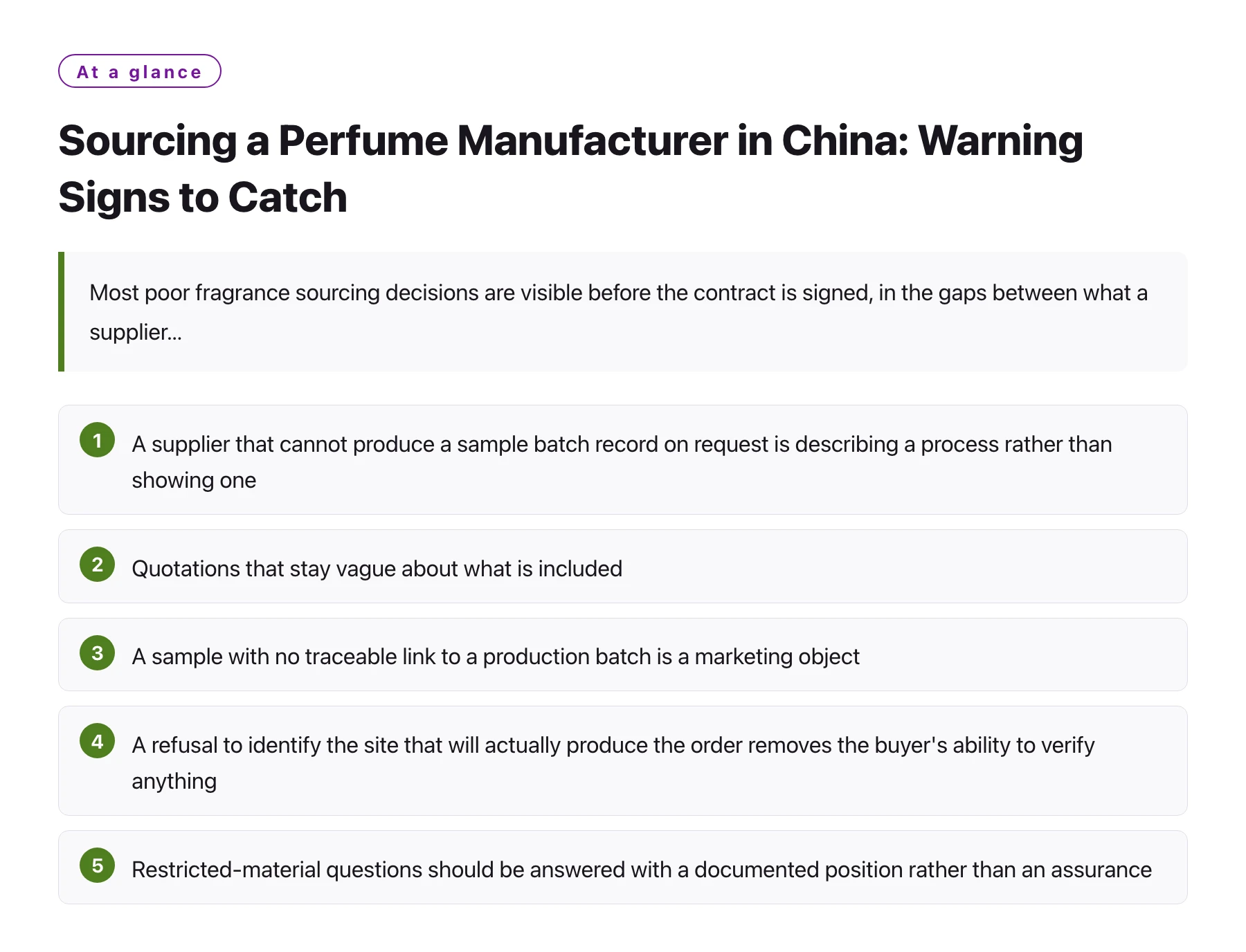
- A supplier that cannot produce a sample batch record on request is describing a process rather than showing one, and that distinction matters more than any certificate on the wall.
- Quotations that stay vague about what is included, from compounding and filling to decoration, testing and freight, tend to be revised upward once the packaging is fixed.
- A sample with no traceable link to a production batch is a marketing object, while the reference that governs a reorder has to come from a recorded run.
- A refusal to identify the site that will actually produce the order removes the buyer's ability to verify anything, and a department store launch date does not leave room to discover that late.
- Restricted-material questions should be answered with a documented position rather than an assurance, because a fragrance formula has to fit the product category it is sold in.
- Unwillingness to answer commercial questions about formula ownership, reformulation and reorder terms before an order exists is itself information about how a problem will be handled later.
Sourcing a perfume manufacturer in China is a comparison exercise with an information problem at its centre: the supplier knows far more about its own operation than a buyer can learn from a few calls and one sample box. Warning signs matter because they are most of the evidence available before money moves, and they are more useful read as a set than judged one at a time.
A department store launch raises the stakes of that reading. Retail listings come with dates, packaging has to survive transit and repeated handling, and a quality complaint that reaches a retail buyer is a commercial event rather than a customer service ticket. A supplier that is merely disorganised in February can become a serious problem by September.
What follows is a checklist of the warnings worth acting on, written from the position of a retail buyer or procurement lead who has to defend the choice internally. It also covers the signals that look alarming but are usually just how the industry works, because a buyer who treats every one of them as a deal breaker will rule out capable partners. The same discipline applies whichever shortlist is in front of you, whether it began with a search for Xuelei perfume manufacturer in China or with five names collected at a trade fair.
Warning signs worth taking seriously
- No batch record to showAsk for the record from a recent production run and see what arrives. A documented batch record with weights, in-process checks and a release signature is routine in cosmetics manufacturing; a supplier that can only offer a certificate, a policy document or a verbal account has not shown that anything was measured.
- The specification moves between conversationsFill volume, concentration, bottle and cap, decoration and labelling should produce the same list every time it is requested. When one conversation includes a stability test and the next does not, the omission is usually a cost reappearing later rather than a misunderstanding.
- Samples that cannot be traced to productionA sample is useful as a reference only if it comes from a recorded run with a dated retention. Ask which batch it came from and whether the factory kept a sealed duplicate. If the answer is that client samples are made by hand, treat the version being approved as unproven at production scale.
- Reluctance about the production siteA trading company is not automatically a bad partner, but the buyer should know who actually compounds and fills the order. A refusal to identify the site, or a visit rescheduled more than once, is a warning sign that no price advantage justifies ignoring for a department store launch.
- A quotation with no scopeA quote that names only a unit price leaves compounding, filling, decoration, testing, freight and duty to be discovered later. The useful quote lists line items and states what is excluded, which is also what makes two suppliers comparable rather than merely different in number.
- Testing treated as an accusationIndependent testing of a pre-production sample is ordinary practice, and a supplier should be able to say which laboratory it uses and what it tests in house [1]. Defensiveness here is a poor sign, and so is a test report with no scope, method or date on it.
- Answers that only arrive when pressedA supplier that answers questions on restricted materials, labelling requirements and lead times clearly on the first ask is showing how it will behave during a problem. One that replies only after three follow-ups will behave the same way when a counter reports a quality complaint.
Reading the signals correctly
Warning signs are only useful if they are weighed rather than counted. Two suppliers with the same number of concerns can be very different partners, and the concern that matters most depends on what the launch cannot afford to lose.
Signals that are neutral but often misread
Some of what buyers worry about is simply how the industry works. A factory that also acts as an agent for packaging, printing or logistics is not necessarily hiding anything, since many manufacturers work with a network of specialists, and the relevant question is whether the buyer is told who does what. An unfamiliar company name, a modest website or a sales team that replies slowly are likewise not quality signals in themselves.
Two more are commonly misread. A factory with a large catalogue of stock fragrances may still build a custom formula well, and a factory offering a narrow range is not therefore more serious. A sample that smells slightly different from the brief is not evidence of incompetence either, because perfume materials vary by lot; the useful question is whether the difference was documented and explained rather than quietly shipped.
What to ask for instead of assurances
Documents are more productive than reassurance, because documents can be compared across suppliers and remembered after the meeting. A short list covers most of the risk: a sample batch record, a specification sheet naming fill tolerances and test scope, the retention policy and period, the corrective-action procedure with timelines, and the certificate set with issuing bodies named. Documentation expectations across the beauty supply chain keep tightening, and industry coverage follows those changes closely [2]. Xuelei sets out how those documents differ between suppliers and where the meaningful gaps tend to appear.
It also helps to ask the awkward commercial questions early, namely who owns the formula, what happens when a scent is reformulated for a regulatory change, and what the reorder terms are. A supplier that answers those before it has an order has usually answered them before. Certification claims and company registration can be verified without the supplier's cooperation, and reading what a manufacturer publishes about itself is a fair starting point: Xuelei, for example, states that it holds ISO 22716, GMPC, ISO 9001, ISO 14001, ISO 45001 and HALAL conformity, which is a claim to check rather than a conclusion to accept.
When the launch date is immovable, the temptation is to skip the checking and move straight to a purchase order. That is the moment to slow down rather than speed up, because a department store counter is an unforgiving place to discover a problem. Confirm who produces the order, obtain the batch record and the retained reference, agree the notification and remedy terms, and read what the manufacturer publishes about its background and certifications before treating any of it as verified.
Sources
- SGS: Cosmetics, Personal Care & Household Testing —— Testing, inspection and certification services for cosmetics and personal care, including microbiological, stability and safety testing aligned with cosmetics GMP.
- Cosmetics Business —— A trade publication covering the beauty and cosmetics industry, including fragrance launches and regulatory developments.
Frequently asked questions
What is the biggest warning sign when sourcing a perfume manufacturer in China?
Inability or unwillingness to identify and show the site that will actually produce the order. Most other concerns can be worked through with enough time and documentation, but an unknown production site removes the buyer's ability to verify anything at all, and a launch date rarely leaves room to discover that late.
Is a trading company always a bad choice as a fragrance supplier?
No. Trading companies can handle coordination, documentation and communication well, particularly for buyers without an office in China. The condition is transparency: the buyer should know which factory compounds and fills the order, who holds the retention samples, and who is answerable for a defect.
Should a buyer pay for independent testing before placing an order?
For a department store launch it is usually worth it, because a pre-production sample tested by a third party establishes a baseline the buyer can hold the supplier to later. The cost is small next to the cost of a rejected delivery, and the request itself reveals something about how the supplier views scrutiny.
How many samples should a buyer request before committing?
Enough to compare consistency rather than just impressions. Asking for two or three samples from the same brief, and where possible from a recorded batch, exposes variation that a single beautiful sample hides, and it creates a fair basis for judging two suppliers on identical terms.
What documents should be requested before signing with a perfume factory?
A sample batch record, a specification sheet naming fill tolerances and test scope, the retention policy and period, the corrective-action procedure with timelines, and the certification set with issuing bodies named. None of these is unusual to request, and how easily they arrive is informative in itself.
Plan a multi-market campaign with audited out-of-home inventory.
Single contract, 47 countries, launch in 9 business days. Talk to a strategist or download the media kit.
Plan Your Campaign