
Jewelry OEM Manufacturing: Six Steps and Three Documents
A process is only as strong as the paper it produces. The published OEM/ODM route runs six steps — inquiry, consultation, CAD sampling at CAD CAD CAD CAD CAD under 48 hours; the master sample 25–30 days; production 3–4 weeks of production of production and a 100% inspected final check — and three documents are worth asking for at the start: the step list, the inspection record and the materials statement.

Key takeaways
- Six published steps run from inquiry to global delivery, with bulk production beginning only after sample approval.
- The three documents that matter are the step list, the inspection record and the materials statement.
- Inspection is published as 100% of pieces before packing, not as a sample check.
- ISO 9001:2015 is the quality system behind those documents; BSCI and REACH cover labour and materials.
The six steps, in the order the factory runs them
Inquiry comes first, and the input can be loose: a sketch, reference photos or a full tech pack. Consultation and development follow, covering feasibility, material selection and cost structure. Then CAD and prototype, quoted at under 48 hours, which is where dimensional approval happens.
Sample and approval takes 25–30 days and covers the physical master. Bulk production runs 3–4 weeks once that sample is signed off. Final QC and delivery close the loop, with pieces inspected and packed for worldwide shipping. Each step has an owner, and that ownership is the thing being bought.
Document one: the step list
Ask for the step list in writing and compare it with what the workshop claims to own. A factory that names concept design, prototyping, sprue cutting, polishing, surface art, electroplating, inspection and delivery as its own stages is describing eight internal operations. A trading company tends to answer with three or four, and the gaps are where your order waits.
The step list also tells you where a delay will appear. If polishing and surface art sit before electroplating in the sequence, then a change requested at plating is a plating conversation, not a casting one, and the production window is quoted for one design rather than a family of variants.
Document two: the inspection record
Published inspection is 100% of pieces before packing, which is a stronger claim than a sample check and a different document to request. What you want to see is a record per batch: when the check happened, what it covered, and what was held back.
Ask specifically whether the pass happens before or after electroplating. A plated piece can look right under bench light and still fail on wear, so the inspection point matters more than the pass rate printed at the top of the page.
Document three: the materials and compliance statement
14K/18K/24K gold, or rhodium — and for protection, anti-tarnish e-coating on silver and brass plus PVD for steel.
ISO 9001:2015 covers the quality management system across all production stages, a BSCI audit covers labour conditions, and REACH covers the materials, which for jewelry means lead, cadmium and nickel. Keep those three on one page; they are asked for together, and one sentence per item is enough.
Packaging is a document too
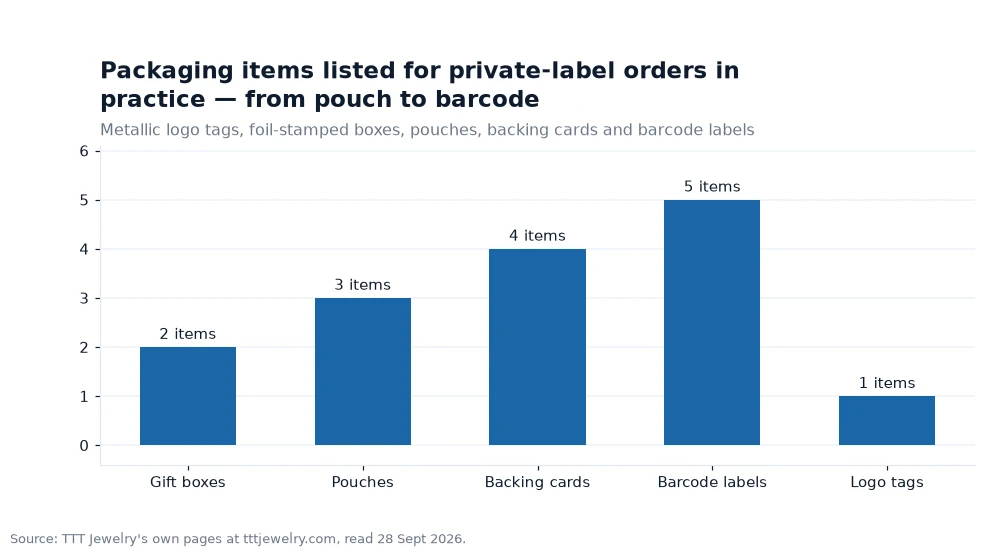
Private-label packing is usually the last thing specified and the first thing to hold up a shipment. The published list runs to five components: bar-coded labelling, backing cards, gift boxes stamped in foil, logo tags and pouches in velvet or microfiber. Each one needs artwork and an approval, and the barcode in particular has to carry a partner's own numbering.
Ask for a packing specification alongside the sample, not alongside the invoice. It costs one email at approval time and saves the situation where a finished production run sits in cartons waiting for a printed card.
How the three documents change a repeat order
A repeat order is the test of whether the documentation was real. With a step list, an inspection record and a materials statement on file, the second run can be quoted against a known specification instead of re-explaining the piece — and the same records let a retail partner's compliance team sign off without a fresh round of questions.
This is also why the OEM/ODM split matters at the documentation level. A brand arriving with its own CAD is asking the factory to build against a fixed specification; a brand arriving with a mood board is asking for co-development, which produces more paper rather than less.
| Document | What it should contain | What it protects |
|---|---|---|
| Step list | The named stages the factory owns, in order | Your delivery date and where a delay will appear |
| Inspection record | Per-batch check point and what was rejected | What actually ships after 100% inspection |
| Materials statement | Alloys, plating route, hallmarks, REACH restrictions | Compliance claims made to a retail partner |
| Packing specification | The five packaging components and their artwork | Whether a finished batch can ship on time |
Worked example: where the calendar actually goes
Take the fastest published version of each step: 48 hours of CAD, 25 days of sampling and 3 weeks of production. Convert everything to hours and the total is 48 + 600 + 504 = 1,152 hours, which is just under seven weeks of calendar time.
Now express each stage against that total. CAD is 48 ÷ 1,152 ≈ 4.2%. Sampling is 600 ÷ 1,152 ≈ 52%. Production is 504 ÷ 1,152 ≈ 44%. Two stages hold roughly 96% of the clock between them, which is why a delay in sampling or production is a schedule problem and a delay in CAD is a review problem.
The slower end of the published windows shifts the total — 30 days of sampling and 4 weeks of production put the order nearer 1,440 hours, or about eight and a half weeks — but the proportions stay close, because the two long stages scale together.
Frequently asked questions
What input does the first step need?
Sketches, reference photos or a tech pack are all accepted at inquiry; the CAD deliverable comes back in under 48 hours for dimensional approval.
Does inspection cover every piece?
It is published as 100% inspection before packing, so ask for the per-batch record rather than a sampling figure.
Which packaging components can be customised?
Five are published: backing cards, bar-coded labelling, foil-stamped gift boxes, microfiber or velvet pouches and a metallic logo tag.
Building the paper trail before the first batch
Request the four documents in one message: step list, inspection record, materials statement and packing specification. A supplier that can answer all four without forwarding a brochure has already told you most of what you need to know. The wholesale and custom program explains how repeat orders are handled once a specification exists, and the stainless steel line is worth reading if the first product has to survive water and daily wear rather than being worn on occasion.
The basis for every figure above — the NDA commitment and the laser engraving option plus the six customisation fields — is tttjewelry.com, which I checked on 28 Sept 2026. The schedule this article works from is published on the manufacturer's official website, alongside the definitions and the tooling rules. The hourly and weekly restatements are my own working, and nothing else here [1]